
The adult world glimpsed through—or better yet, juxtaposed with—children’s eyes is brutally honest.
What is it about grandparent-grandchild relationships? They might be affectionate together but barely understand each other; nonetheless, the supposed wisdom of age and socially ascribed values of seniority automatically assume absolute obedience from the younglings and hence rigid boundaries. The little girl in Céline Sciamma’s Petite Maman (2021) has a life-changing encounter with the younger versions of her grandmother and mother upon the former’s death, which magically closes the gap between generations. A less magical account of a pair of young siblings’ visit to their grandparents’ country home while their mother fights for her life, Hou Hsiao-Hsien’s A Summer at Grandpa’s (1984) reiterates the emotional distance between them. Now another Taiwanese filmmaker and a long-time collaborator of co-writer and producer Sean Baker, Tsou Shih-Ching, offers an honest portrayal of a Left-Handed Girl, whose involuntary reception of her grandparents’ influences and all the shame-driven familial conflicts strikes a chord with this writer from a similar Hongkongnese/Chinese background.
Having newly moved to Taipei, the eponymous five-year-old I-Jing is seen commuting in her much older sister I-Ann’s arms on a motorcycle and running through the night market where their single mother Shu-Fen works. On top of the continued tension between Shu-Fen and I-Ann, the maternal grandparents’ persistent management of I-Jing’s behavior and curiosity sets the tone of Left-Handed Girl—unnerving for I-Jing, yet quietly farcical for the audience as we witness her annoyance and dejection. “Children should listen, not talk.” “Kids don’t know any better.” These adults keep shutting I-Jing up without hesitation, reducing her to a quiet, naive observer of her family’s chaos for the most part. Except when she commits certain “sinful” acts that lend the film its title.
Although not played as a grown-up I-Jing’s flashback, the semi-autobiographical Left-Handed Girl is a gratifying introspective work that expertly parses what shapes a Chinese woman.
With maximum force and full-on superstition, the grandpa repeatedly commands I-Jing to use her right hand because the “devil’s hand” must not be indulged. She reluctantly listens, soon completely buys into the myth, and then shoplifts with it. Curiously, her character arc—turning her “devil’s hand” into a vessel of petty thefts—transpires pretty much in a sub-plot fashion despite her titular status. The things she does and the way she’s simply there, however, intricately weave the other plotlines into a time bomb of family crises. I-Ann and Shu-Fen are increasingly hostile to each other amidst the estranged patriarch’s impending death; Shu-Fen’s sisters, who mock and bawl and sneer non-stop, seem to perpetually judge her for how she handles things; if the grandparents do have any valuable wisdom, they choose to keep it to themselves and exhibit their worst versions; last but not least, I-Ann is having an affair with her boss, whose wife will soon deliver a shocking revelation that descends into the ultimate “losing face” scene. Most of these events are accompanied by I-Jing’s presence, a presence so contrasting and inappropriate that one wonders what family trauma is already lurching around underneath her innocent face.
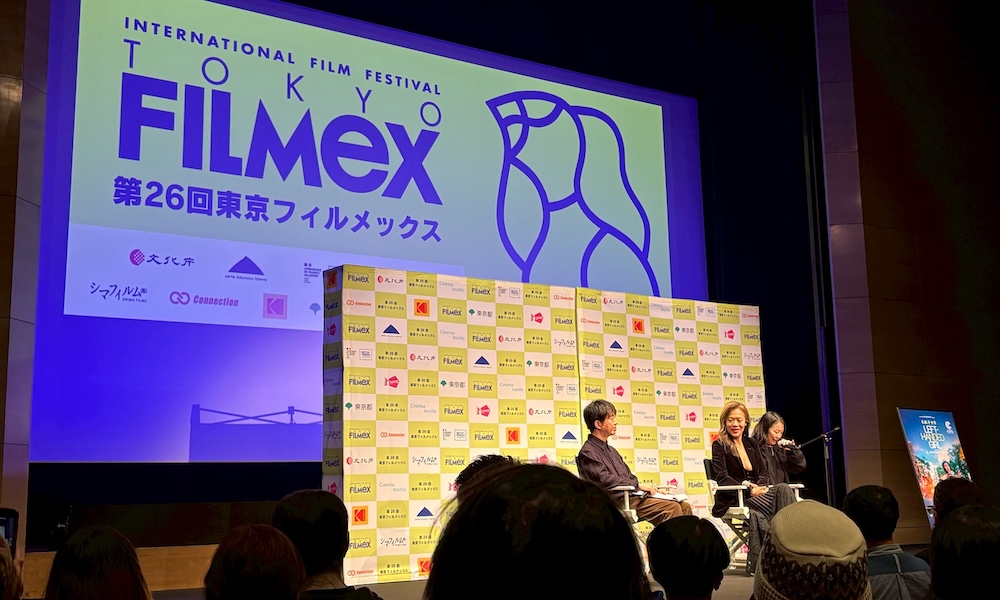
Tsou told her audience at Tokyo Filmex 2025 that the vibrant colorscape of Taipei, the kaleidoscope I-Jing plays with in the opening scene, and the many low camera angles that transport us to her position signify the motifs of childhood—never-ending exploration, ever-shifting vibrations going on in a kid’s head, and sponge-like absorption of ideas. But there’s no schmaltzy romanticization of child-like innocence; I-Jing is surrounded by her working mother and sister suffering financial and romantic troubles, unsupportive grandparents, and spiteful aunties who do everything but prevaricate. It is this constant juxtaposition of I-Jing’s distorted comprehension of familial “teachings” and her family members’ almost shameless talks about what’s right and wrong that singles out Left-Handed Girl as a penetrative character study of girlhood in Chinese cultures.
Rarely does a film that centers a child make its viewers worried more about the surrounding adults than the child. That sense of emotional displacement is not only a key component of an accurate portrait of many Chinese family dynamics, but also a welcome subversion of childhood film tropes. The chess prodigy in Searching for Bobby Fischer (1993) and the child actor who becomes more successful in her acting career than her father in I’ll Do Anything (1994) are never left alone because of their unparalleled talent in what they do and become burdened with the adults’ manipulation, ambitions, and emotional overwhelm. Dark fantasies such as Pan’s Labyrinth (2006) and A Monster Calls (2016) (a personal favorite of the genre) send their child protagonists off to gloomy adventures in picture book-like worlds as children’s ways to cope in dire times. In dreamlike dramas like The Spirit of the Beehive (1973), Petite Maman, and Aftersun (2022), the mysteries of life, perception, and remembrance are narrativized in entangled temporalities that constitute the child’s reality or childhood memories. All of the above films either translate the child’s internal struggles into fantastical experiences or foreground the child’s extraordinary individuality that outsmarts or embarrasses the adults. The characterization of I-Jing as a mostly non-interfering spectator brings about a refreshing outlier that hammers home its point: whether or not something unpleasant is directed at the child, there are psychological repercussions all the same.
Of course, not every Chinese family is like I-Jing’s, one filled with judgmental and comparison-obsessed members. And surely—well, probably—not that many Chinese families bear seriously “face”-damaging secrets. Regardless, Tsou’s assemblage of familial friction and minor clashes is satisfyingly acute and unmistakably true to Chinese family life. Although not played as a grown-up I-Jing’s flashback, the semi-autobiographical Left-Handed Girl is a gratifying introspective work that expertly parses what shapes a Chinese woman.
Left-Handed Girl is available exclusively on Netflix.

Heidi Ka-Sin Lee is a film researcher and a lecturer in the Department of English Studies at Sophia University. She earned her PhD in international culture and communication studies from Waseda University. Her research interests include queer cinema, cognitive film theory, character engagement, film music, and intermedial adaptation. She has published articles on lesbian-centered films and series in journals such as Senses of Cinema and USC’s Spectator as well as The Routledge Handbook of Motherhood on Screen.



