
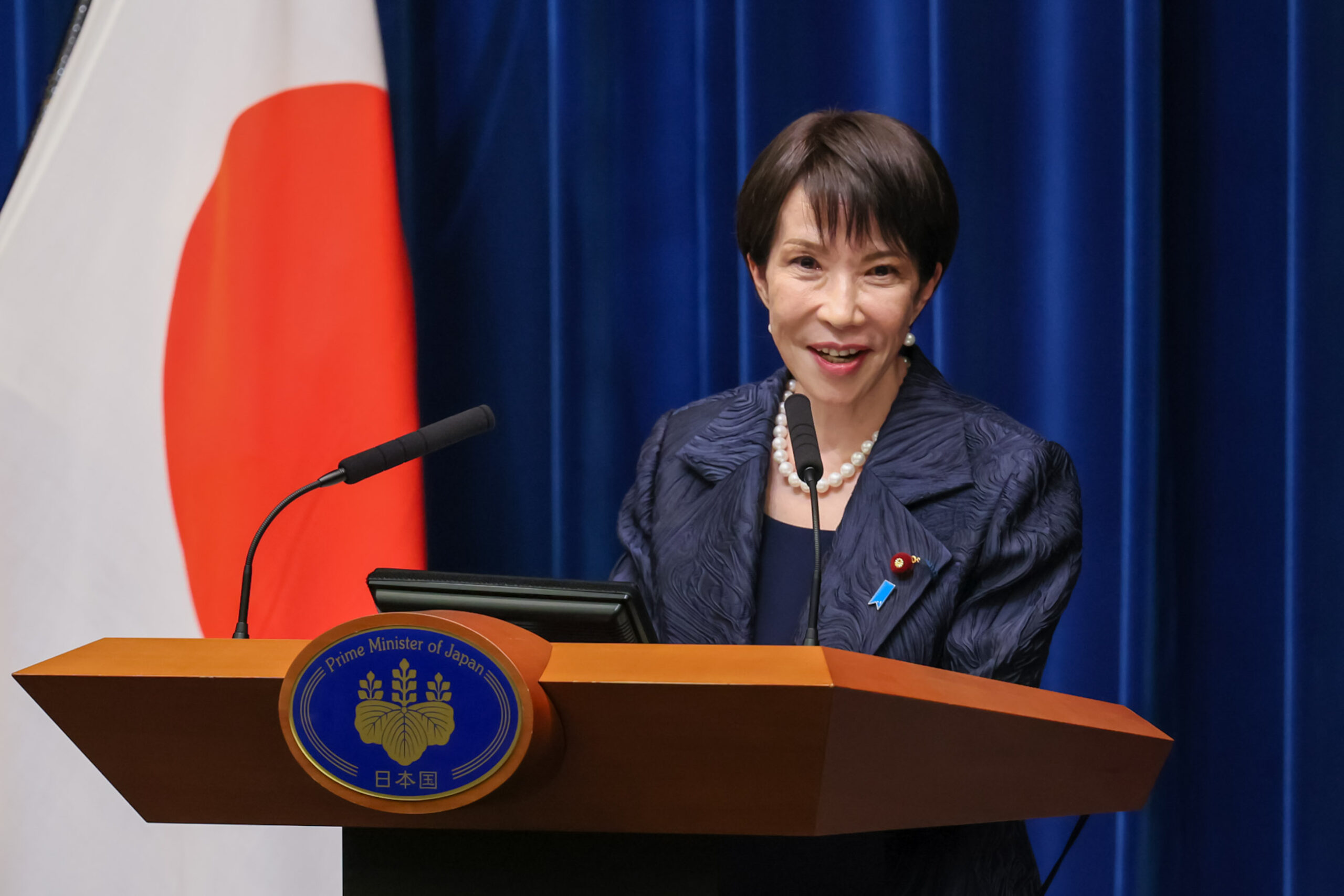
The new year has kicked off with Prime Minister Sanae Takaichi calling a general election to “ask the sovereign people to decide” whether to support her and the new Liberal Democratic Party (LDP)-Japan Innovation Party (Nippon Ishin no Kai) partnership.
While the prime minister has enjoyed historically high approval ratings, questions remain as to whether the ruling parties will maintain control over legislative affairs given the gap between her approval and LDP approval and the emergence of a new centrist alliance between the main opposition Constitutional Democratic Party and former coalition partner Komeito.
With the political paradigm shift still taking shape from a largely one-party dominated system to a multi-party system, Takaichi and the LDP are still finding their feet amid the seismic shifts in political alignment.
Assuming that she survives this election test, achieving a semblance of stability will require smooth sailing in 2026, particularly stabilizing the new partnership with Ishin after a largely successful rollout that was not without some moments of tension.
The LDP-Ishin partnership, which effectively replaced the two-decade old LDP-Komeito coalition, has had some highs and lows in the first few months since its inception.
On the one hand, the two parties quickly institutionalized the policy making process and hammered out the FY 2025 supplemental budget and the FY 2026 annual budget and tax system reform outline before the end of the year. The former was enacted during the 2025 extraordinary Diet session, while the latter initially received support from the opposition Democratic Party for the People (DPFP) and is likely to enjoy majority Diet support for enactment.
As a minority government, the LDP has been forced to make compromises with Ishin and with certain opposition parties to ensure legislation moves through the Diet, a challenging task that Takaichi’s predecessor Shigeru Ishiba also had to deal with. Unlike her predecessor, who struggled to suppress internal frustrations over excessive compromises, Takaichi skillfully made concessions to secure funding for much-needed inflation relief measures and enacted all eleven bills that the government submitted.
The trial run wasn’t without its issues though. The LDP and Ishin have differing approaches and timelines pertaining to key initiatives included in the policy agreement signed back in October 2025, such as electoral reform, the second capital initiative, and defense-related reforms.
Assuming that she survives this election test, achieving a semblance of stability will require smooth sailing in 2026.
The homework left over from 2025 was largely accepted on both sides—despite signs of frustration among the rank-and-file—due to the fact that both sides understood the realistic constraints in a short 58-day extraordinary Diet session.
The real test begins on January 23 when the Diet convenes for a full 150-day session.
Failure to make progress on key policy promises will sow discord between the two parties and call into question the benefits of the partnership. A breakdown in relations would slow down the prime minister from making meaningful progress on policy priorities in an already “twisted” Diet in which the LDP will still lack a majority in the Upper House even if the ruling parties secure a majority in the upcoming Lower House election.
The February 8 election constitutes the first major test of 2026. Takaichi aims to strengthen her position amid a challenge from a new centrist alliance with strong voting machines behind them. This “January surprise” will also see Komeito’s votes, some 10,000 to 20,000 votes per single-member district, move over from the LDP to the new alliance.
Calling an election within less than a year into her tenure allows Takaichi to capitalize on high approval in the 60 and 70 percent range but calls into question whether high approval for her Cabinet truly translates to good showing at the polls for the LDP. Recent opinion polls do, however, show that the LDP maintains a double-digit lead over other parties and that the momentum has slowly started to match Cabinet approval.
Election cooperation has been a missing piece in the LDP-Ishin partnership, which is a confidence and supply arrangement rather than a full-fledged coalition along the lines of the preceding LDP-Komeito relationship with clear electoral benefits.
The LDP and Ishin will engage in competition in the upcoming election, which could pose problems for the sustainability of the partnership if both sides cost each other critical seats. News reports suggest that there are approximately 65 contested seats between the ruling parties.
After the election, Takaichi will also have to confront the question of whether to bring the DPFP into the fold for further stability, though a three-party coalition could create more problems than benefits.
Some in the LDP view the DPFP as a more stable partner for the LDP, reportedly courted by Takaichi back in October 2025. The party carries a sizable portion of the labor vote that the LDP covets. DPFP leader Yuichiro Tamaki has also openly flirted with the idea, though Takaichi’s decision to hold an early election has undermined trust between the parties.
Unlike Ishin, which jumped into the partnership and is building trust with the LDP in the present tense, the DPFP has been cautious and opted for building trust with Takaichi on a policy-by-policy basis. Its support for last year’s supplemental budget and verbal support for this year’s annual budget signals close alignment on key policies.
The DPFP’s presence as a potential partner has been welcomed by Ishin but could be leveraged by the LDP as a counterweight to Ishin’s threats to withdraw from the partnership when things don’t go their way. Should the DPFP join the partnership post-election, it would dilute Ishin’s influence as the LDP could negotiate separate deals and still get to a majority in the Diet to enact legislation.
The first full year of Takaichi’s tenure as prime minister requires stabilizing her party’s partnership with Ishin amid a series of policy- and election-related challenges, and the prospect of having to address how the DPFP may or may not fit into the LDP-Ishin dynamic.
On top of that, she will have to deal with mounting foreign policy challenges, from the Japan-U.S. tariff deal implementation to deteriorating Japan-China relations.
Takaichi may have sailed through 2025 relatively well, but she faces her most consequential tests in 2026.

Rintaro Nishimura is a Tokyo-based Senior Associate in The Asia Group’s Japan practice, where he researches and analyzes domestic political shifts, economic security, and technology policy developments. He is a co-founder of the U.S.-ROK-Japan Next-Gen Study Group, a platform for young professionals to regularly discuss issues pertaining to the trilateral relationship. He graduated with a MA in Asian Studies (MASIA) at Georgetown University’s School of Foreign Service, focusing his studies on the U.S.-Japan alliance, economic security in the Indo-Pacific, and Japanese domestic politics. He has extensive writing experience, having published in the Georgetown Journal of Asian Affairs, Nikkei Asia, The Interpreter, The Diplomat, The National Interest, Tokyo Review, and Asia Tech Observer. He has also been quoted in BBC, CNN, Reuters, Bloomberg, Nikkei Asia, Voice of America, Al Jazeera, and CNBC. He can be found on Twitter (@RinNishimura) and http://rintaronishimura.com.





