
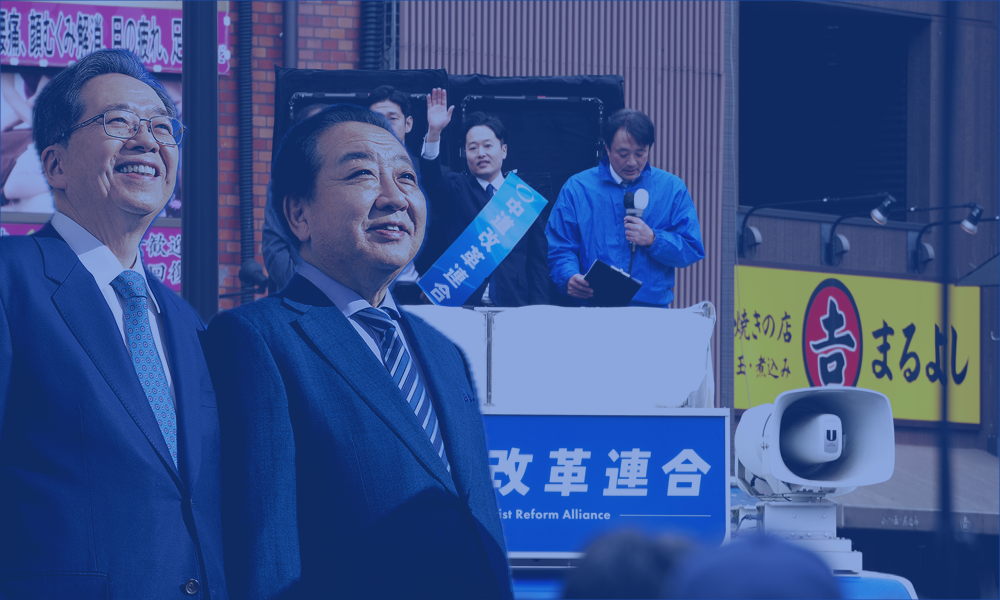
The biggest surprise in an already difficult-to-predict election has been the merger of the Constitutional Democratic Party of Japan (CDP) and the ruling party’s former coalition partner Komeito into the new Centrist Reform Alliance (CRA). This brings the new party’s total number of seats in the Lower House to 173—barely a stone’s throw away from the ruling party’s 198 seats. The opposition has never gotten this close to challenging the Liberal Democratic Party (LDP) since the Democratic Party of Japan (DPJ) lost the 2012 Lower House election.
The party argues that they are concerned with the polarization of the political landscape. But this idea of the moderate center, while attractive to opposition elites, is unlikely to resonate strongly with the electorate. Instead, whatever enthusiasm that such a development would have once generated is being scattered across a swathe of anti-establishment challenger parties who now have an unprecedented opportunity to leave their mark on politics.
The CRA, or Chūdō Kaikaku Rengō (中道改革連合) in Japanese, is headed by both the former leaders of the CDP and Komeito, Noda Yoshihiko and Saitō Tetsuo. Its formation happened on short notice, adding extra drama to an already high-risk election. Interestingly, the merger itself occurred with few hick-ups (apart from noted conspiracy peddler Haraguchi Kazuhiro starting a new challenger party), raising confidence that this will finally consolidate the opposition into a force that can properly challenge the LDP.
The party’s policies, however, remain vague. CRA’s platform centers on the consumption tax and welfare. In this sense, the new party is continuing the general platform promoted by the CDP in both the 2021 and 2024 Lower House elections: No consumption tax on foodstuffs and the expansion of basic services. Considering that these are both policies promoted by the LDP’s campaign as well, it is hard to say exactly where the CRA differs.
Where the CRA differs from the CDP is with regards to security policy. In particular, the CRA has taken the position that former PM Abe Shinzō’s controversial security legislation allowing Japan to exercise collective self-defense is constitutional. This is a sharp departure from the CDP, which was founded during a moment when politics was strongly divided on the issue. Attitudes towards defense have changed dramatically, and it is likely that Noda was keeping his eyes open for any opportunity to divest itself from that legacy in order to take a more proactive security position.
With few differences in terms of economic and security policy, the CRA can only truly distinguish itself on the basis of its social progressivism. But this topic has taken a back seat to the unfolding cost-of-living crisis and the recent row with China around Japan’s hypothetical reaction to an invasion of Taiwan. If the CRA is meant to present an alternative vision to the LDP, it is not a particularly evident one.
In spite of the party’s vagueness, its formation makes a great deal of sense due to the characteristics of the electoral system. There are two separate ballots that voters will have to fill in at the polls: One for a single candidate in their district where there can only be one victor; and one for their block’s party list, with seats distributed to the parties based on the proportion of votes they each receive. On the whole, the system incentivizes parties to either coordinate candidate selection or, better yet, merge into a unified opposition.
The CRA is being positioned as the latest step towards the consolidation of an alternative to the LDP. In this way, its self-styled “centrism” can be read as a call for other parties and candidates from both sides of the aisle to join the party once the election ends. Indeed, much of the CRA’s rhetoric is derived from the debates around the electoral reform efforts of the early 1990s, when political entrepreneurs such as Ozawa Ichirō sought to reshape Japan’s political environment so as to produce a moderate conservative alternative to the LDP. If this is the goal, then a status quo result for the CRA (preferably with some key wins in head-to-head races) is its own victory.
But it is now unlikely that the CRA will achieve even that. Newspapers are reporting a likely landslide victory for the LDP, primarily on account of Takaichi’s popularity. That said, an upset is still a distinct possibility. Worried that these reports will persuade her supporters to stay home during the predicted bad weather on Sunday, Takaichi urged voters to go to the polls regardless in a video on YouTube.
If a last minute upset fails to materialize then that likely spells the end of the long-term project of unifying the opposition. As the political scientist Nakakita Kōji recently argued, opposition elites have operated on an interpretation of the electoral system that has always been erroneous. After all, even the LDP has had need of its special relationship with Komeito to prop up the electoral dominance of its candidates.
Furthermore, over the past two years, Japanese politics has fragmented into a larger number of parties that seek to answer specific gaps in the political marketplace. Sanseitō, for instance, quickly grew in size while promoting fringe conspiracy theories. These parties do not have broad support, but they have the ability to split votes in SMD races. They can also affect policy through agenda-setting and framing, as was arguably the case with recent debates on Japan’s immigration policy.
The rapid decline of the CRA will most likely accelerate this trend, even if the short-term consequence is a consolidation of the LDP. Even a major victory for Takaichi does not restore the party to its previous position in Japanese politics. It will simply make it more reliant on the popularity of its leaders as its relationships sour and resources dwindle.
The fantasy of the two-party system as a democratic ideal has haunted the decisions made by Japan’s liberal opposition. It may be time to finally put it to bed.

Romeo Marcantuoni received his Ph.D. from the Graduate School of Asia-Pacific Studies at Waseda University. He is currently an Adjunct Lecturer of Political Science at Temple University, Japan Campus. He earned his MA and BA in Japanese Studies at KU Leuven, Belgium. His current research focuses on interpretive approaches to the study of political parties from the perspective of emotions and narrative.





