
Following her decisive Lower House victory, Prime Minister Takaichi Sanae signaled plans to devote greater resources to strengthening Japan’s defense posture. Given the Liberal Democratic Party’s newfound supermajority, Takaichi will have the political backing to pursue more ambitious security initiatives, including an early revision of Japan’s three core strategic documents: the National Security Strategy (NSS), National Defense Strategy (NDS), and Defense Buildup Program. Revisions to these documents function as moments of preference revelation, clarifying how an administration interprets threats, prioritizes capabilities, and allocates resources. The Kishida Administration’s 2022 revisions, for example, revealed a decisive shift toward acquiring counterstrike capabilities, raising defense spending toward 2 percent of GDP, and expanding alliance integration with the United States. Yet those same documents contained a foundational gap. While they outlined ambitious military and technological objectives, they gave limited attention to the energy constraints that would shape Japan’s ability to sustain those capabilities in a crisis. How the Takaichi government approaches NSS revisions will not only signal its strategic priorities, but also determine whether this core energy security gap is finally addressed.
Energy underpins every function of Japan’s defense capabilities. Military operations, logistics, command and control, intelligence gathering and analysis, and the AI-enabled systems that increasingly underpin these functions all depend on a stable and reliable energy supply. Japan’s recent 7th Strategic Energy Plan and the more glamorous Green Transformation (GX) and Digital Transformation (DX) programs have put energy security in the legislative spotlight. GX promotes an ambitious 2050 decarbonization agenda through carbon pricing and emissions regulations, while DX focuses on modernizing Japanese industry and cybersecurity through the integration of AI, IoT, and cloud technologies.
Yet despite the breadth of these initiatives, they stop short of framing energy as a core security necessity—and therefore a potential liability. While the NSS does acknowledge the risks of supply disruption, coercion, and infrastructure strain, it does not meaningfully integrate energy security into its strategic logic. Instead, it largely assumes stable energy access rather than treating energy insecurity as a core constraint. This assumption is evident both in the limited attention the NSS devotes to the issue and in its repeated pairing of energy with food security, which implicitly frames energy as an aspirational objective rather than a resource requiring active strategic management.
This divergence highlights a dangerous mismatch between the assumptions embedded in Japan’s defense plans and the structural constraints facing the country’s energy grid.
Japan’s reliance on imports for roughly 85 percent of its total energy supply means that any disruption to international energy flows during a conflict would directly constrain Tokyo’s capacity to sustain national defense. While the NSS asserts that Japan will “maximize the use of energy sources that contribute to its energy self-sufficiency, such as renewable energy and nuclear power,” this objective sits uneasily with Japan’s actual nuclear energy potential. Analysis by the Renewable Energy Institute characterizes this vision as “excessively ambitious,” noting that Japan’s nuclear capacity is unlikely to approach the level required to sustain domestic baseload energy production.
Meanwhile, global energy consumption has surged in recent years, driven in part by the explosive growth of artificial intelligence and data infrastructure. The International Energy Agency projects that Japan’s AI-related electricity consumption alone could increase by roughly 15 terawatt-hours by 2030, an increase of around 80 percent. Yet the NSS’s heavy emphasis on advanced digital and AI capabilities includes zero discussion of the vast energy systems required to sustain them.
Domestic infrastructure presents its own separate challenge. As Japan accelerates electrification across civilian and military systems, grid resilience becomes a critical determinant of military readiness. Japan’s electricity grid is unusually fragmented compared to other advanced economies. Its dual-frequency system and limited interregional interconnections constrain power sharing between eastern and western Japan, limiting flexibility in large-scale emergencies, which heightens the risk that regional grid stress could escalate into broader system instability. Yet grid resilience is largely absent from Japan’s defense planning. This divergence highlights a dangerous mismatch between the assumptions embedded in Japan’s defense plans and the structural constraints facing the country’s energy grid.
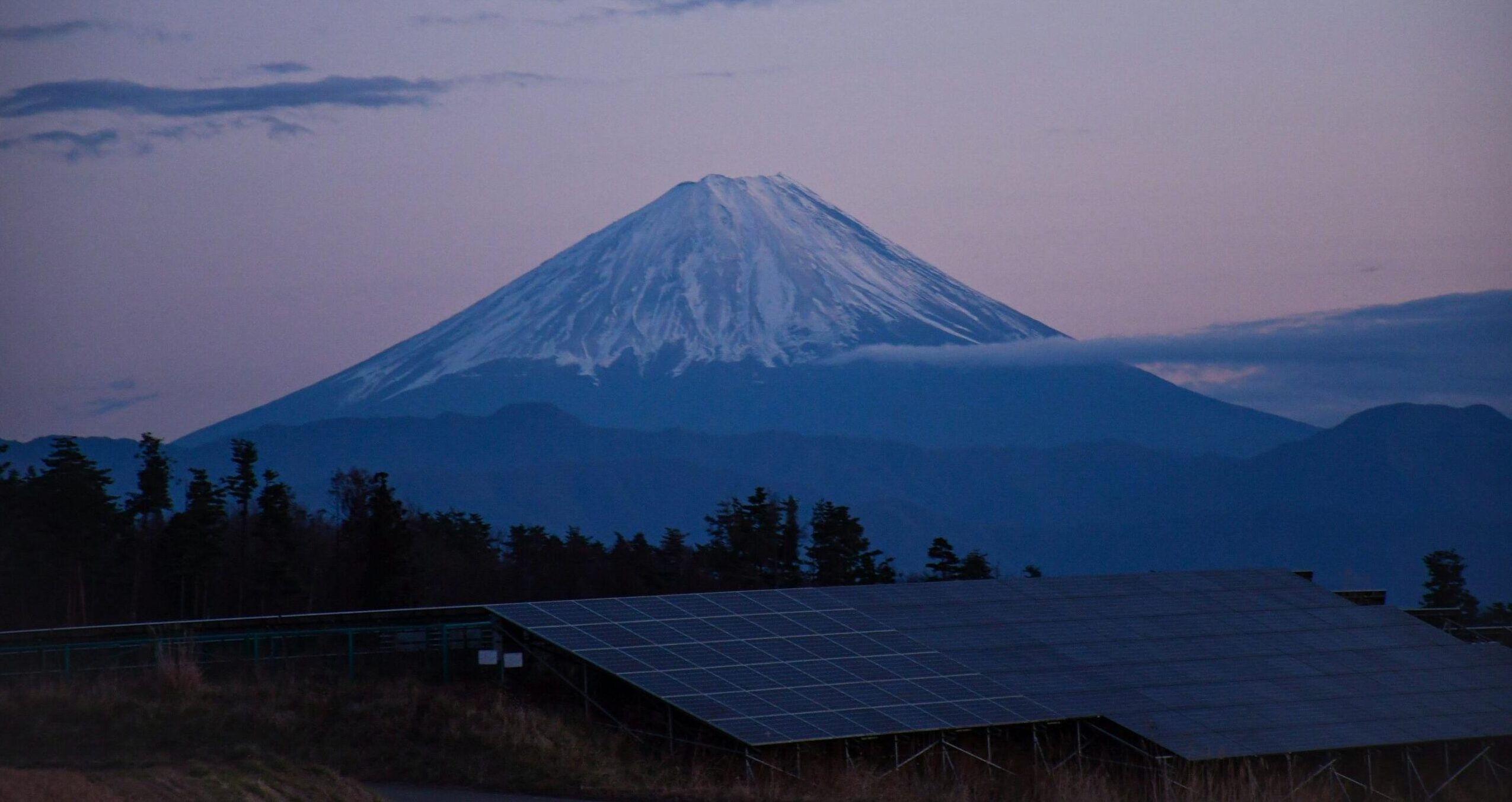
Despite substantial gains following the introduction of the 2022 feed-in-tariff scheme designed to increase the adoption of renewable energy via fixed energy prices, a 2025 study by the Institute for Energy Economics & Financial Analysis (IEEFA) found that renewable energy deployment in Japan has stagnated, with installation and generation growth reaching their lowest levels in over a decade. Solar and other renewable energies offer an attractive pathway toward domestic energy production, but much of the global solar supply chain—around 80 percent—is concentrated in China. While some emerging technologies like perovskite solar cells show potential for scalability, Japan’s current reliance on Chinese-manufactured solar panels risks substituting one form of supply-chain risk for another, further complicating energy security objectives at a time of heightened geopolitical tension.
The 2019 attack on the Japanese-owned tanker Kokuka Courageous during its transport of crude oil in the Strait of Hormuz was a wake-up call for Japanese officials. However, despite efforts to reroute supply lines and shift to crude oil alternatives, other maritime choke points, like the Strait of Malacca, remain sources of vulnerability. Japan’s ability to sustain operations under trade pressure or supply disruption directly informs the operational calculus of the United States and other partners. Thus, while Prime Minister Takaichi pledged a “new golden age of the Japan-U.S. alliance” and committed to “further enhance deterrence and response capabilities,” energy security may unintentionally become a source of diplomatic tension if left unaddressed.
Japan does not need to rewrite its security strategy from the ground up; it needs to integrate it more effectively. Bringing energy security explicitly into the NSS would align strategy with material constraints and strengthen its credibility and execution. It would strengthen crisis and contingency planning by factoring energy availability, grid resilience, and fuel logistics into strategic assessments. And it would increase coherence across defense, climate, industrial, and infrastructure policy, signaling to allies and adversaries alike that Japan is actively addressing a core strategic vulnerability.
Energy security is not an abstract concern or a technocratic detail. It is a foundational component of both economic and national security. Any strategy that overlooks the material conditions that sustain power risks becoming aspirational rather than operational. By more directly integrating energy security into the NSS, Japan can ensure that its national strategy reflects not only its ambitions but also the realities that must guide planning to sustain them in a crisis.

Helen Cecile Nowatka is a Master's student at the Walsh School of Foreign Service, Georgetown University in Asian Studies. Her research interests include political economy and energy policy, with a regional focus on Asia.



