
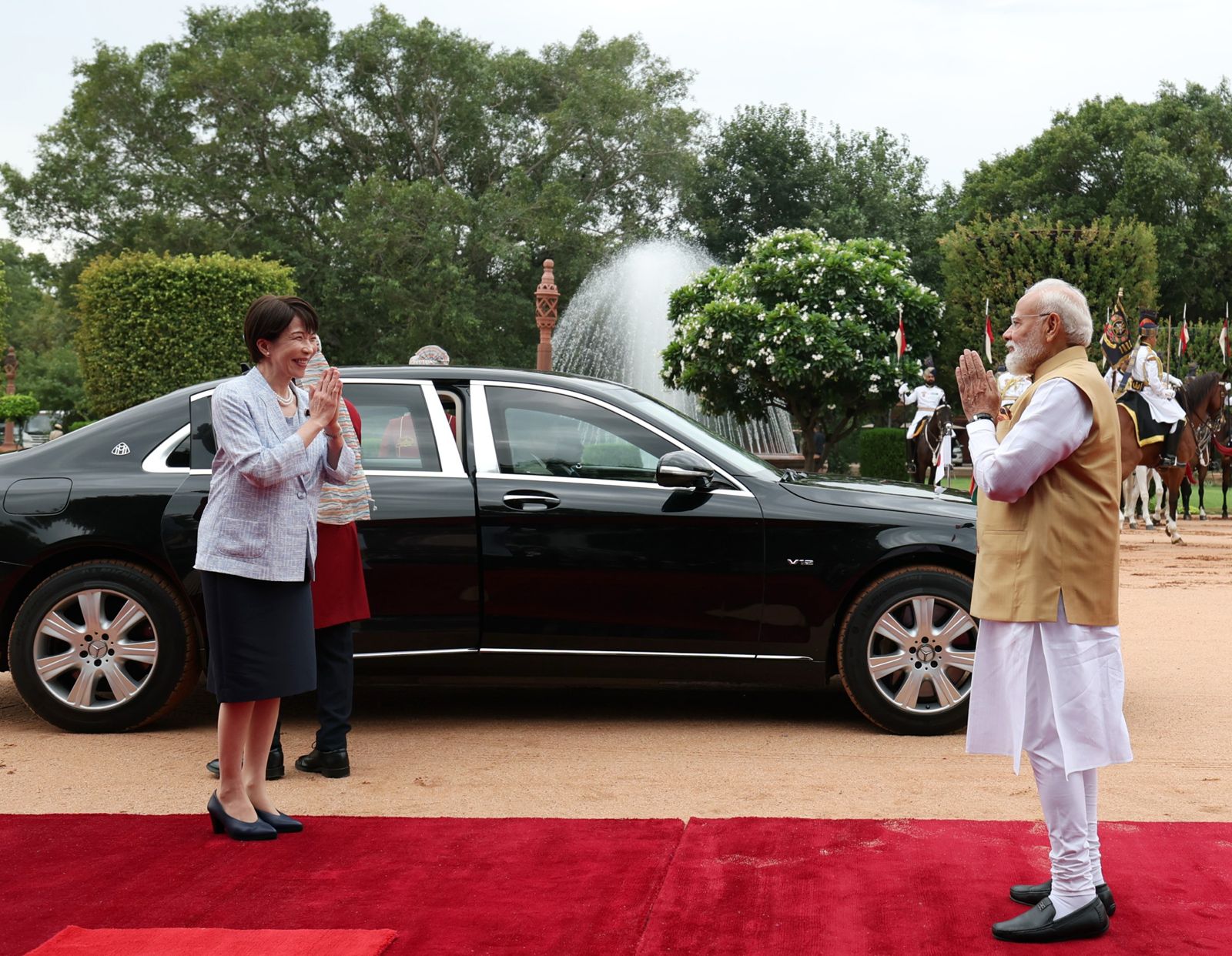
When Prime Minister Sanae Takaichi concluded her three-day visit to India from July 1-3, the warmth on display was hard to miss. Prime Minister Modi introduced her as his younger sister, a gesture of closeness rarely extended to a foreign head of state. The two governments announced multiple bilateral initiatives at the 16th Annual Summit, anchored by a Joint Declaration on Economic Security and joint statements on energy resilience and artificial intelligence. Over 50 leaders from Japanese companies and organizations traveled with the prime minister for the Joint Economic Forum. By any measure, it was a substantive visit.
Yet a familiar interpretation is surfacing in post-summit conversations at policy seminars across New Delhi. With Washington pressing both Tokyo and New Delhi on tariffs and burden-sharing, some observers are reading Japan’s outreach to India as a hedge against an increasingly unpredictable Washington, a sign that even America’s closest allies are preparing alternatives. Skeptics also cite the disparity in recent Japanese investment pledges, USD 550 billion to the United States versus USD 62 billion to India by 2035, as evidence that the India-Japan relationship remains junior at best. This sort of commentary implies that India-Japan ties should be measured against the U.S.-Japan alliance.
Both of these oversimplifications misread Tokyo’s strategic calculus toward India. It would be a mistake for observers to view strengthening India-Japan cooperation as a sign of weakening U.S.-Japan cooperation. It would be equally unwise to evaluate the present value and future trajectory of Japan’s bilateral ties with India through a side-by-side comparison of investment pledges into the world’s largest economy; Japan’s history of massive foreign direct investment in the United States renders such comparisons meaningless.
India’s and Japan’s difficulties with the Trump Administration are real, but Tokyo’s relationship with Washington rests on foundations that tariff friction alone is unlikely to unsettle. Consider what continues to anchor the U.S.-Japan alliance. The Treaty of Mutual Cooperation and Security, in force since 1960, commits the United States to Japan’s defense in the event of an armed attack. Around 60,000 American troops are stationed on Japanese soil, more than in any other country in the world. Successive administrations since Obama, including both Trump terms, have affirmed that the U.S. defense commitment to Japan extends to the full range of American capabilities, including nuclear, and covers the Senkaku Islands, which China also claims. That guarantee matters because China is the alliance’s central threat. Beijing’s military modernization and its assertive maritime activity near Japanese-administered territory present a persistent strategic challenge. Tokyo’s response has been to raise defense spending and integrate the Japan Self Defense Forces more closely with U.S. forces. In such a security environment, Japan is unlikely to treat even a promising partnership with India as a substitute for a treaty alliance backed by extended nuclear deterrence guarantees.
So, what then should India make of the Takaichi visit and the current trajectory of its relationship with Japan? The answer is exactly as the two governments stated: a “Partnership of Strategic Convergence,” a bilateral partnership worthy of consideration on its own terms, not merely through juxtaposition with Japan-U.S. or India-U.S. relations.
U.S. political volatility complicates the alliance; it does not define it nor fundamentally jeopardize it. Even while Japanese policymakers have had to navigate tariffs, burden-sharing demands, and policy uncertainty from U.S. administrations, Tokyo has continued to modernize and invest in the alliance’s underlying institutions. Shinzo Abe established this approach to managing U.S.-Japan relations during Trump’s first term. Takaichi, his protégé, is applying it now. Tokyo’s working assumption is that administrations change and treaties remain. The alliance has survived the “Nixon Shock” in 1971 and the Reagan-era trade disputes of the 1980s. It will survive this presidency too.
So, what then should India make of the Takaichi visit and the current trajectory of its relationship with Japan? The answer is exactly as the two governments stated: a “Partnership of Strategic Convergence,” a bilateral partnership worthy of consideration on its own terms, not merely through juxtaposition with Japan-U.S. or India-U.S. relations.
Tokyo and New Delhi both face the harsh realities of weaponized supply chains, energy insecurity, and dependence on China for critical minerals and pharmaceutical ingredients. The recent India-Japan summit addressed those shared vulnerabilities directly, emphasizing three priority areas of cooperation in economic security, energy resilience, and technology. The center of gravity in the bilateral relationship is unmistakably commercial. During the summit, Prime Minister Modi noted that nearly 129 private-sector agreements had been concluded over the past year, opening the way for more than JPY 2 trillion in Japanese investment. Energy security, defense technology co-development, and semiconductor resilience: the priorities announced at the summit, all point the same way. Business is at the heart of this relationship; economic security cooperation is what will keep it beating for years to come.
This emphasis on commercial ties should be read as a strength of the partnership rather than a constraint. But it also means the U.S.-Japan alliance is the wrong yardstick to measure the India-Japan relationship against. The U.S.-Japan alliance was built to deter a shared military threat; India-Japan cooperation is being built around de-risking shared economic vulnerabilities. Judged against a treaty alliance designed for deterrence, a business-led partnership will always look thin. Judged on its own terms, as an answer to a different and increasingly urgent set of problems, the India-Japan relationship looks like a promising strategic partnership. Japan’s outreach to India is thus better understood as diversification within an alliance framework, rather than preparation of an escape route.
The more useful question is whether commercial depth can translate into social depth: familiarity and trust between the two societies, not just connectivity between their governments and businesses. The relationship today still runs through ministries, summit communiqués, and business delegations. Its long-term future will be shaped by how well the two societies come to know each other: the students and the tourists who move between them are markers of growing bilateral ties. The leaders have designated 2027, the 75th anniversary of diplomatic ties, as the Year of Shared Horizons. Whether that year becomes one of substance or ceremony will say more about this partnership’s future than near-term anxiety about Washington.
Judged on its own terms, as an answer to a different and increasingly urgent set of problems, the India-Japan relationship looks like a promising strategic partnership.



